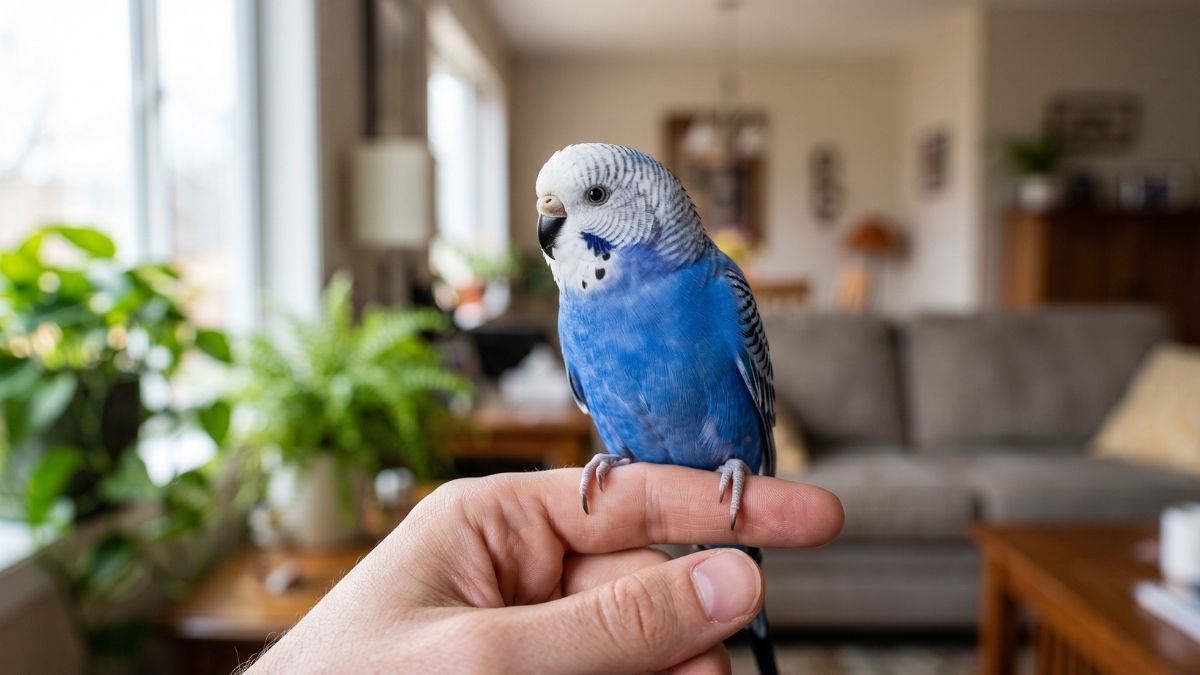
Do parakeets get attached to their owners? Yes, many do. Budgies can form strong social bonds with the people who care for them, and some clearly develop a preference for one person.
The reason partly goes back to their natural social behavior. Budgies live in flocks, where staying connected with other birds is important. They use contact calls to keep track of each other, perch close together and groom one another.
A pet budgie can carry these social instincts into the home. The person who feeds it, talks to it and interacts with it calmly every day may become an important part of its social world.
But budgies don’t all show attachment in the same way. There is no single behavior that proves a bird “loves” its owner. Instead, look for a pattern of relaxed, voluntary behavior over time.
If you’re new to keeping a budgie, our Parakeet Care Guide covers the basics of daily care.
7 Clear Signs Your Parakeet Is Attached to You
No single behavior proves a bond. Look for a pattern over days and weeks, and consider each sign alongside your bird’s overall body language and mood.
1. Making Happy Vocalizations and Contact Calls
A relaxed budgie may chatter, sing and chirp when you’re nearby.
You may also notice contact calls. These are short calls birds use to stay in touch with others when they are separated. Your budgie may call when you leave the room and respond when you talk back.
A bird that vocalizes freely around you is often comfortable in your presence.
That’s a useful sign of trust, although vocalization by itself doesn’t prove that your bird is attached to you.
Mimicry is a bonus, not a requirement. A budgie that copies your voice or household sounds may be particularly engaged with its surroundings, but plenty of friendly and attached budgies never learn to speak.
If you’d like to encourage talking, see our guide on how to teach your budgie to talk.
One caution: if a normally vocal bird suddenly becomes very quiet and shows other changes in behavior, don’t assume it is simply upset. Contact an avian veterinarian if you’re concerned.
2. Choosing to Stay Close to You
A budgie that voluntarily lands on your shoulder, hand or head may be showing a high level of trust.
Stepping onto your finger willingly is especially useful to watch for because the bird is choosing to interact with your hand rather than avoiding it.
Watch what your bird does when it is outside the cage.
Does it repeatedly return to you? Does it choose to perch near you? Does it remain relaxed while sitting nearby?
Those behaviors can indicate that your bird feels comfortable around you and enjoys your company.
Body language matters too. A relaxed posture and normal feathers are very different from a bird that is stiff, wide-eyed or frozen in place.
3. Gentle Beak Grinding While Relaxed
Beak grinding is a soft, raspy sound produced when a budgie rubs its upper and lower beak together.
It is commonly associated with relaxation and often happens when a bird is settling down to rest.
If your budgie grinds its beak while comfortably perched near you, it suggests that your presence isn’t making it feel threatened.
It’s a useful sign of comfort, although it is less direct as an attachment signal than voluntarily seeking you out.
4. Gently Preening Your Hair, Nails or Skin
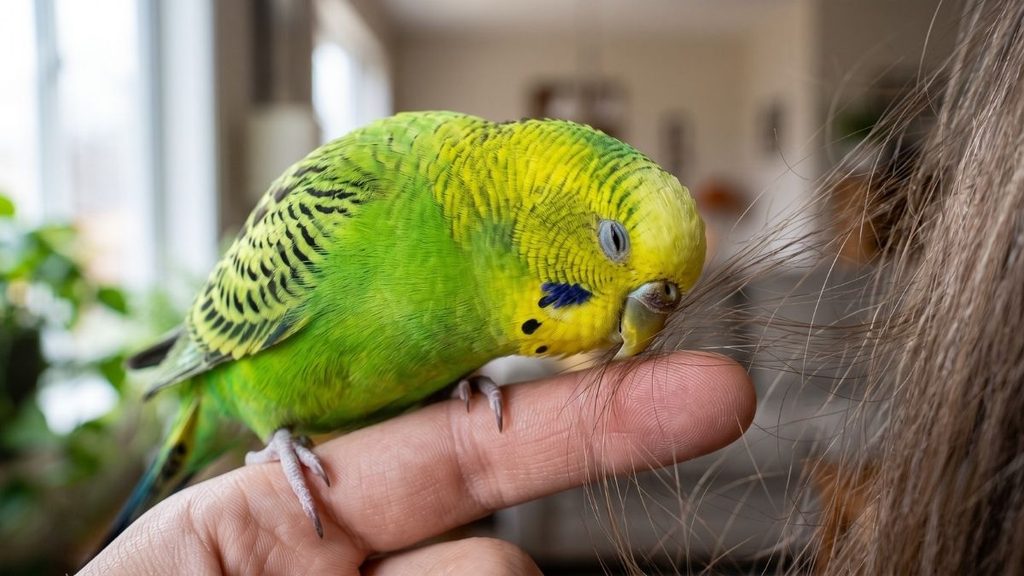
Budgies naturally groom their flock mates. This behavior, known as allopreening, helps birds maintain their feathers and is part of their social interaction.
A budgie may sometimes direct gentle grooming behavior toward a trusted person, such as lightly nibbling at hair or fingernails.
This can be a sign that the bird is comfortable interacting with you.
The key word is gentle.
A hard bite is different. If your bird starts biting forcefully, becomes stiff, hisses or tries to move away, give it some space.
5. Regurgitating Food for You
This behavior can surprise new budgie owners.
Budgies may regurgitate food as part of courtship or social bonding behavior. A bird may direct this behavior toward another bird, a toy, a mirror or, in some cases, a person it is strongly attached to.
If your budgie does this toward you, it may indicate that the bird sees you as an important social companion.
However, don’t automatically assume every instance of regurgitation is affection.
Repeated regurgitation, vomiting or regurgitation accompanied by signs of illness is different and should be discussed with an avian veterinarian.
Watch for other symptoms such as lethargy, fluffed feathers or food around the face and neck.
6. Tail Wagging and Excited Eye Pinning
A quick side-to-side tail wag can happen when a budgie is excited or comfortable, particularly during interaction with a familiar person.
However, don’t use tail wagging alone to decide whether your bird is happy or attached. Always look at the rest of its body language.
Eye pinning, where the pupils rapidly become smaller and larger, is even more context-dependent.
It can occur during excitement or curiosity, but it can also happen when a bird is highly stimulated or agitated.
Look at the whole bird:
- More relaxed: loose body posture, normal vocalization and curiosity
- More concerning: stiff posture, hissing, lunging or other defensive behavior
Also don’t confuse tail wagging with tail bobbing.
If your bird’s tail repeatedly moves up and down with each breath, particularly when accompanied by difficult or heavy breathing, contact an avian veterinarian.
7. Following You Around the Room
A budgie that watches where you go, flies toward you or moves to the side of the cage when you walk past may be showing strong interest in you.
This fits with the social nature of budgies. Birds naturally pay attention to members of their social group and often prefer to stay connected.
If your budgie consistently chooses to be near you while remaining relaxed, that’s one of the easier signs of a developing social bond.
Not every bird will show all seven signs. Personality matters, and some budgies are naturally more independent than others.
How Long Does It Take for a Budgie to Bond With You?
There is no fixed timetable.
A confident, well-socialized bird may become comfortable relatively quickly, while a nervous bird can take considerably longer.
Think of the following stages as a general guide, not a deadline.
Days 1 to 7: The Acclimation Phase
A new budgie has just experienced a major change in its environment.
During the first week, focus on helping it feel safe rather than trying to make it tame immediately.
- Talk quietly when you pass the cage.
- Move slowly and avoid sudden gestures.
- Keep handling to a minimum while the bird settles in.
- Make sure it is eating and drinking normally.
The goal is simple: let your bird learn that its new environment is safe.
Weeks 2 to 4: The Curiosity Phase
Once your budgie is eating normally and moving around the cage confidently, it may start showing more interest in you.
This is a good time to introduce hand presence.
Place your hand near or inside the cage without trying to grab the bird. Let your budgie observe it and decide when it feels comfortable approaching.
Food can help.
A small amount of millet or another suitable treat can teach your budgie that your hand predicts something positive.
Some birds step onto a finger quickly. Others need weeks.
Neither is automatically a problem.
Months 2 and Beyond: Building Deeper Trust
As trust develops, you may see behaviors such as:
- Stepping onto your finger willingly
- Choosing to perch near you
- Following you around
- Relaxing while you’re nearby
- Interacting with you voluntarily
- Allowing gentle interaction without trying to escape
The important difference is that the bird is choosing interaction rather than simply tolerating it.
Trust also needs to be maintained. Rough handling, repeated scares or forcing interaction can set progress back.
Patience Isn’t Optional
Every budgie has its own temperament.
Trying to force a nervous bird to bond faster can have the opposite effect. A frightened bird may learn that hands and people are things to avoid.
The fastest way to build trust is often the slowest-looking approach: calm, predictable interaction repeated every day.
Do Single Parakeets Bond Better Than Pairs?
It depends on the birds and on how much time you can give them.
Budgies are social flock birds, so a single budgie may rely heavily on human interaction for companionship.
With plenty of daily attention, a single budgie can become very tame and strongly attached to its owner.
But there is an important trade-off.
A pair provides another budgie for social interaction throughout the day. Because of that, two birds may naturally spend more time with each other.
That doesn’t mean a pair cannot become tame or bond with people. It simply means that their social attention may be divided between their bird companion and their owner.
Neither setup guarantees a close bond.
If you keep a single budgie, you need to be prepared to provide substantial daily interaction. If you cannot reliably provide that attention, keeping a compatible companion may be worth considering.
How Space Affects Stress and Socializing
Living space matters in either setup.
A cage that is too small can restrict exercise and contribute to stress. A stressed bird is less likely to be comfortable during social interaction.
This can be especially important when keeping two birds together because they need enough room to move away from each other when they want to.
Our budgie cage size guide covers cage dimensions for one, two or more birds.
Building Trust Through Daily Routine and Care
Bonding doesn’t start with training sessions.
It starts with the basic care your bird depends on every day:
- Fresh food and water
- A clean cage
- Enough sleep and quiet time
- Safe opportunities for exercise
- A predictable routine
- Calm interaction
Predictability helps your bird learn what to expect.
Over time, your budgie can learn that your presence is associated with food, safety, conversation and positive experiences.
Health matters too.
Birds can hide signs of illness, so a sudden change in behavior should not automatically be interpreted as a relationship problem.
If your budgie suddenly becomes withdrawn, stops eating or behaves very differently from normal, contact an avian or exotics veterinarian.
Handling That Builds Trust
How you handle your budgie matters as much as how often you interact with it.
- Approach slowly and avoid sudden movements.
- Let it come to you rather than grabbing it.
- Keep sessions short and finish while the bird is still relaxed.
- Never punish biting or attempts to escape.
- Pay attention to body language. Retreating, hissing or stiff posture means your bird needs space.
For the complete basics of keeping a budgie healthy and comfortable, see How to Take Care of a Parakeet: A Beginner’s Guide.
Proven Ways to Deepen Your Bond
Bonding grows from small, repeatable moments.
A few calm minutes every day can be more useful than a long session that overwhelms your bird.
Use Your Voice
Talk to your budgie regularly in a calm voice.
You can say its name, describe what you’re doing or simply talk while you’re nearby.
Budgies are highly social and naturally use vocalizations to maintain contact, so regular calm conversation can become part of your bird’s routine.
Keep Your Hands Calm and Predictable
Move slowly and let your bird see your hand before it gets close.
Offer a finger and wait instead of reaching for the bird.
Over time, your budgie can learn that your hands are predictable and safe rather than something that suddenly grabs it.
Try Slow Blinking
Some bird keepers use slow blinking or a softer gaze as a calm interaction with their birds.
There isn’t strong veterinary evidence that slow blinking specifically means “I love you” to a budgie, so don’t treat it as a proven communication technique.
The useful part is keeping your own body language calm and non-threatening.
Start Simple Target Training
Target training teaches a budgie to touch a target, such as a stick or target pointer, in exchange for a reward.
It is a simple way to introduce positive reinforcement.
- Hold the target near your bird and reward any interest.
- Reward your bird when it touches the target.
- Gradually increase the distance.
- Keep sessions short and end on a successful repetition.
Make Treats Work for You
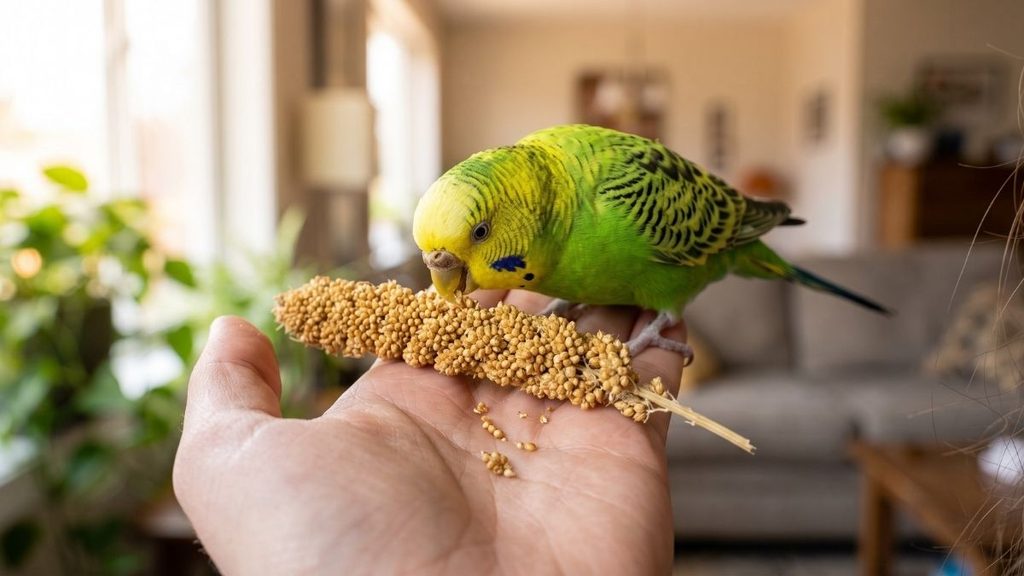
A high-value treat can help your bird associate you with positive experiences.
Spray millet is commonly used for budgie training, but keep portions small because treats should not replace a balanced diet.To make sure you are offering the right nutritional balance and safe snacks, check out our complete budgie diet and safe foods guide.
You can also use a small amount of an appropriate vegetable that your bird already enjoys.
Reward behaviors you want to see more often, such as:
- Coming closer
- Stepping onto your finger
- Touching the target
- Remaining relaxed around you
A budgie’s trust is earned a little at a time.
Each calm greeting, each treat taken from your fingers and each quiet evening spent together can become part of that process.
Your bird may show attachment differently from another budgie. That’s normal.
The goal isn’t to make your bird behave affectionately on command. The goal is to create an environment where your budgie feels safe enough to choose interaction with you.
Sources & Further Reading
- VCA Animal Hospitals: “Budgies – Feeding“
- VCA Animal Hospitals: “Recognizing the Signs of Illness in Pet Birds“
- Merck Veterinary Manual: “Management of Pet Birds“
- Lafeber Company: “Budgie Taming and Social Behavior“
This article is for general education and is not veterinary advice. If your budgie’s behavior, appetite or health changes suddenly, contact an avian or exotics veterinarian.