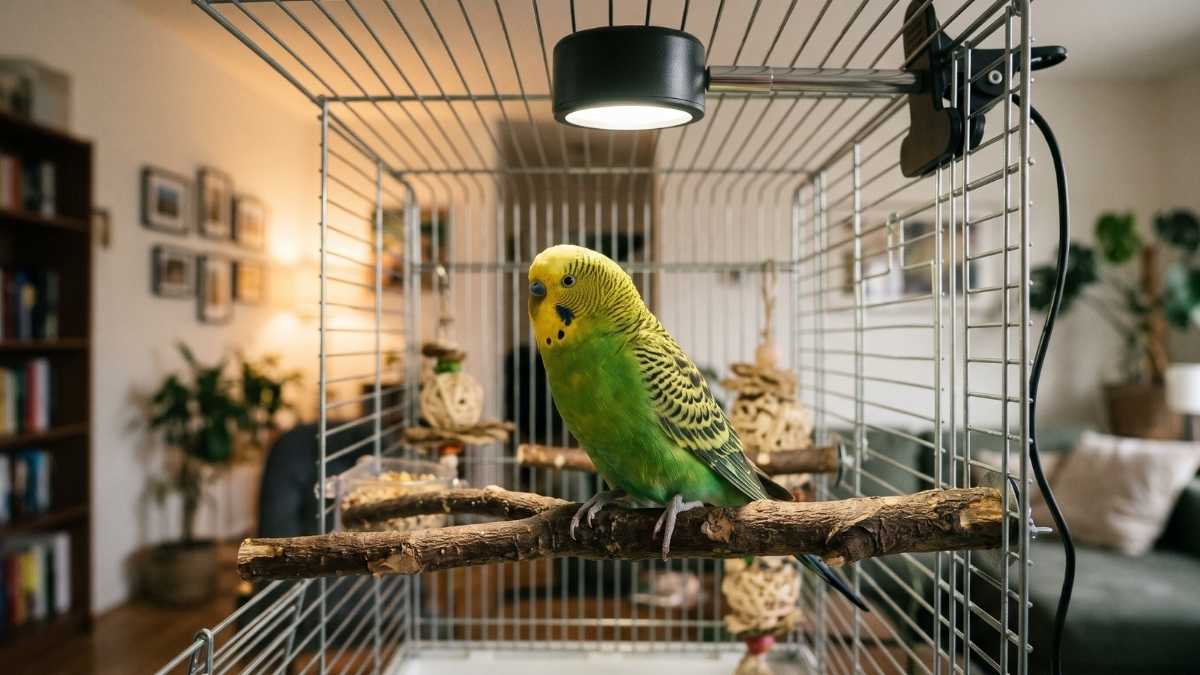
So, do budgies need sunlight? Yes, but not in the way most owners assume, and a sunny windowsill does not meet the need. A budgie’s light requirements differ from ours, and understanding those differences is an important part of good husbandry for any pet parakeet.
What Birds Actually Require from Light
Humans perceive color through three types of cone cells. Birds have four. This tetrachromatic vision can extend into the ultraviolet A (UVA) range, allowing a parakeet to see colors, patterns, and contrasts that are invisible to us. In the wild, budgies use their vision to assess food and potential mates. Plumage that looks uniform to a human may reflect UVA in ways that are not visible to us. Ordinary household lighting may not reproduce the full range of natural daylight, including UVA.
Light also plays a role in a bird’s vitamin D metabolism. UVB radiation in the 290–315 nm range helps birds produce vitamin D3. In some bird species, UV exposure can act on compounds in preen oil, which birds then ingest while preening. Vitamin D3 helps the body absorb and regulate calcium, supporting bone strength, muscle and nerve function, and eggshell formation. Vitamin D deficiency can result from an unbalanced, seed-based diet or insufficient UVB exposure. Calcium and vitamin D needs should therefore be considered together, with a balanced diet and veterinary guidance forming the foundation of care.
Most indoor homes do not provide reliable UVB exposure, so how you light your bird’s space matters alongside what you feed it.
Why Sunlight Through a Window Does Not Work
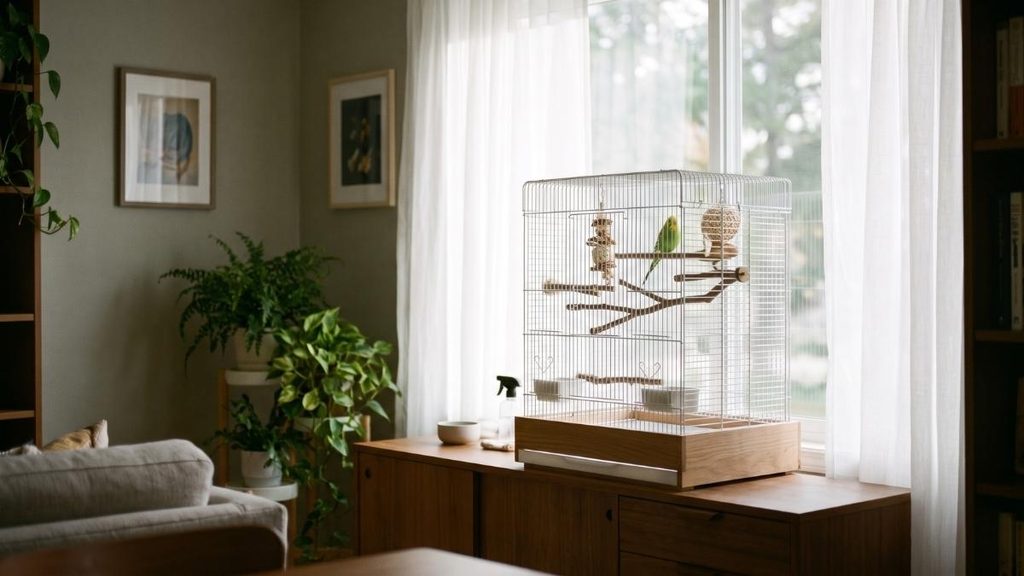
Many owners ask whether budgies can get sunlight through a window, and the answer is that the light arrives but most of the useful UVB does not. Standard residential glass blocks nearly all UVB radiation, including much of the 290–315 nm range involved in vitamin D3 production. A budgie can sit in a bright window for hours without receiving meaningful UVB exposure. How much UVA passes through depends on the type of glass, its coating, and whether it is tinted or laminated.
What glass does transmit is visible light and infrared radiation, which can create heat. That creates the second problem: the greenhouse effect. Sunlight passes through the pane, warms the surfaces inside, and the heat can build up. A cage in a sunny window can reach dangerous temperatures, even on a mild day. Budgies cannot sweat, and they shed heat mainly by panting and holding their wings away from the body. In an enclosed cage without a shaded retreat, a bird may have no escape route. Early signs of heat stress include:
- Open-beak panting and rapid breathing
- Wings held away from the body
- Lethargy or clinging to the cage bars
Left unchecked, overheating can progress to collapse and death. Avian veterinary references identify overheating as a preventable emergency.
Windows also bring drafts, particularly from older frames, and the temperature swing between a sun-baked afternoon and a cold glass-side night can be hard on a small bird. Placing the cage near bright indirect light, but away from direct panes, is far safer. Our guide on where to put a budgie cage explains how to choose a bright, stable spot that avoids both overheating and drafts.
Comparing Budgie Light Sources: Natural vs Artificial
Not every bright light does the same job. Each source below delivers a different mix of visible light, UV, and heat, and each carries its own risks.
- Filtered Window Light: Window light is useful for brightness and for setting a natural day-night rhythm. However, ordinary window glass blocks most UVB, so window light cannot replace a direct source of UVB.
- Direct Outdoor Sunlight: Unfiltered outdoor sunlight can provide natural UVA and UVB. It also brings overheating, predators, and escape risks, so it demands close supervision and access to shade. Our guide on putting a budgie cage outside covers safe setup in detail.
- Dedicated Avian UV Lighting: For indoor birds, a suitable bird-specific UV light may help provide UV exposure when safe outdoor sunlight is not available. However, the term “full spectrum” does not guarantee that a bulb produces useful UVA or UVB. Output varies by product, so check the manufacturer’s specifications and discuss suitable lighting with an avian veterinarian.
Comparison of Light Sources for Companion Parakeets
| Light Source | UVB Delivery | Main Benefit | Safety Precautions |
| Filtered Window Light | Most UVB blocked by ordinary glass | Bright daylight cues and a natural photoperiod | Avoid direct panes overheating and drafts are possible |
| Direct Outdoor Sunlight | Natural UVB when conditions allow | Natural UV exposure and outdoor enrichment | Constant supervision, shaded retreat, secure carrier or cage, predator protection |
| Bird-Specific UV Lamp | Varies by product and distance | Can provide controlled UV exposure indoors | Follow product-specific distance and exposure guidance, provide shade, replace on schedule |
Choosing and Using a Lamp
- Choose products specifically designed for birds, rather than using reptile lamps or other high-output UV equipment without veterinary guidance. Excessive UV exposure can injure a bird’s eyes and skin.
- Prefer flicker-free fixtures. Birds can perceive flicker that humans may not notice, and unsuitable lighting may cause stress.
- Position the lamp so your budgie can move away from it and has shaded areas in the cage.
- Replace bulbs according to the manufacturer’s schedule, since UV output can decline before the visible light becomes dim.
- Avoid PTFE (Teflon)-coated bulbs or fixtures. When overheated, PTFE can release fumes that are extremely dangerous to birds.
Avian veterinary guidance supports considering appropriate UV exposure for companion birds, but the correct product, distance, and duration matter. Dietary calcium and vitamin D, along with your veterinarian’s guidance, remain essential parts of care.
Providing Safe Outdoor Natural Sunlight
Unfiltered outdoor sunlight is a natural source of UVB, but the amount of UV exposure a bird receives depends on factors such as location, season, weather, and time of day. The Association of Avian Veterinarians suggests supervised outdoor exposure sessions, commonly around 20 to 30 minutes two to three times a week. This is general guidance, not a guaranteed vitamin D3 dose for every budgie. More is not necessarily better, and a short, well-managed session is safer than leaving a bird exposed for long periods.
Non-Negotiable Outdoor Rules
- Constant supervision: Stay within arm’s reach for the entire session. Hawks, cats, crows, and even stray dogs can strike or frighten a bird within seconds, and fright can trigger panic flights and injury.
- Locked, secure enclosure: Use a cage or travel carrier with a latched door and no wide bar spacing. Never rely on a harness or open perch for a bird that is not trained, and never allow free flight outdoors.
- Partial shade at all times: Position the enclosure so one side stays shaded. Your parakeet should be able to choose between sun and cover, and you should never place the cage on pavement or in a fully exposed spot.
- Mild temperatures: Aim for a comfortable, calm day. Skip sessions during heat, strong wind, high humidity, or cool, damp weather. Review our guide on what temperature is too cold for budgies before taking a bird out in shoulder seasons, since chilling is as real a risk as overheating.
- Fresh water within reach: Offer a small dish so your bird can drink whenever it needs to.
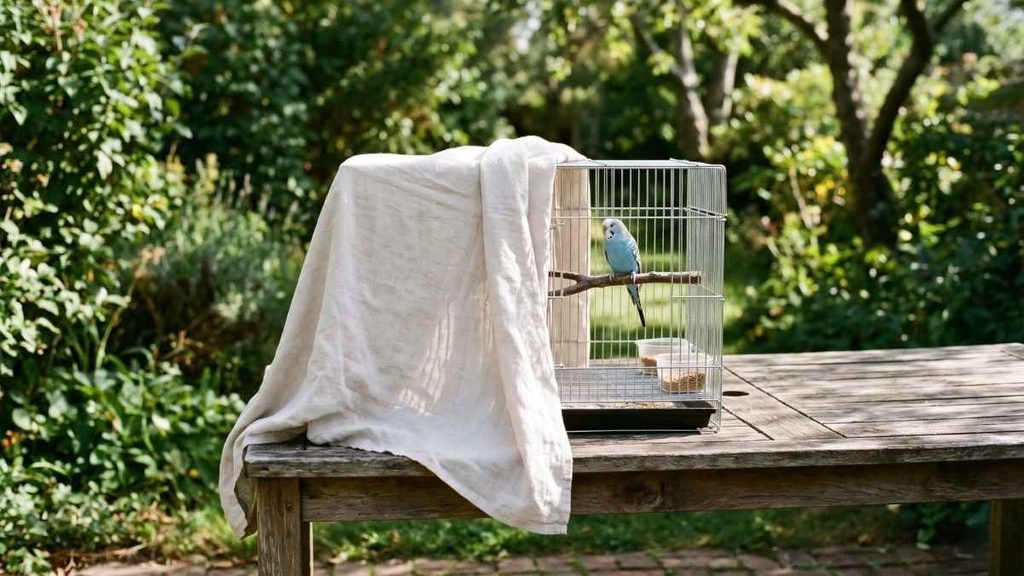
End the session immediately if you see open-beak panting, wings held away from the body, or lethargy. Move the bird to a cool, shaded room and contact an avian veterinarian if the signs persist.
Before the first outing, check for toxic plants, pesticide or fertilizer use, and chemical lawn treatments nearby. Our full guide on putting a budgie or parakeet cage outside walks through site selection, acclimation, and a step-by-step first-session routine.
Indoor Avian Full-Spectrum Lights & Daily Photoperiod
When outdoor time is limited, a suitable bird-specific UV lamp may help provide UV exposure indoors. Understanding how much light does a budgie need daily matters as much as the bulb itself, because the daily light-dark cycle also influences hormones and behavior.
Selecting an Avian-Specific Bulb
- Choose products specifically designed for birds. Check the manufacturer’s specifications to confirm whether the bulb provides UVA, UVB, or both. The label “full spectrum” alone does not confirm that a lamp provides useful UV output.
- Avoid reptile bulbs unless your avian veterinarian recommends a specific product. Some reptile lamps produce UV levels that may be unsuitable for a small bird and can cause eye or skin injuries.
- Look for a high color rendering index (CRI) and flicker-free ballasts or LEDs. Birds can perceive flicker that humans cannot, and unsuitable lighting may contribute to stress.
- Skip PTFE-coated bulbs and fixtures. Overheated Teflon-type coatings can release fumes that are extremely dangerous to birds.
Positioning the Lamp
Position the fixture according to the manufacturer’s exact distance and exposure guidance. There is no single safe distance that applies to every lamp, because UV output varies by product and setup. Keep the cord, socket, and bulb completely out of beak reach, because budgies chew. Make sure the light reaches the birds without passing through glass or plastic, which can block much of the UVB. Leave part of the cage shaded so your parakeet can step away. Replace bulbs on the manufacturer’s schedule, since UV output can decline before visible brightness does.
The Daily Photoperiod Rule
Aim for a consistent daily routine that provides around 10 to 12 hours of light followed by 10 to 12 hours of uninterrupted darkness. Longer days can act as a breeding cue, and excessive or inconsistent lighting may contribute to reproductive behavior in some birds, including excessive egg laying and aggression. Egg laying can also deplete calcium reserves. Use a simple outlet timer for consistency if needed.
Darkness must be genuine. Streetlights, television glow, and hallway lamps can interrupt rest and may contribute to night frights. Our guide to budgie night frights explains how to create a dark, quiet sleep environment that keeps your bird calm after lights-out.
Conclusion & Educational Disclaimer
So, do budgies need sunlight? Natural sunlight provides UVB that helps with vitamin D3 production and calcium metabolism, as well as UVA that contributes to their visual experience. A predictable day-night rhythm is important too. Safe, supervised outdoor time or a suitable bird-specific UV lamp may help provide UV exposure, while 10 to 12 hours of darkness each night supports a consistent routine. A balanced diet and regular veterinary checkups complete the picture.
References: Companion avian medicine standards, including Clinical Avian Medicine, Avian Medicine: Principles and Application, and educational guidelines from the Association of Avian Veterinarians.
Educational Disclaimer: This guide is for general education and does not replace advice from a qualified avian veterinarian. Recommendations reflect companion-bird veterinary resources. Consult your vet about your bird’s individual lighting, health, and calcium needs.