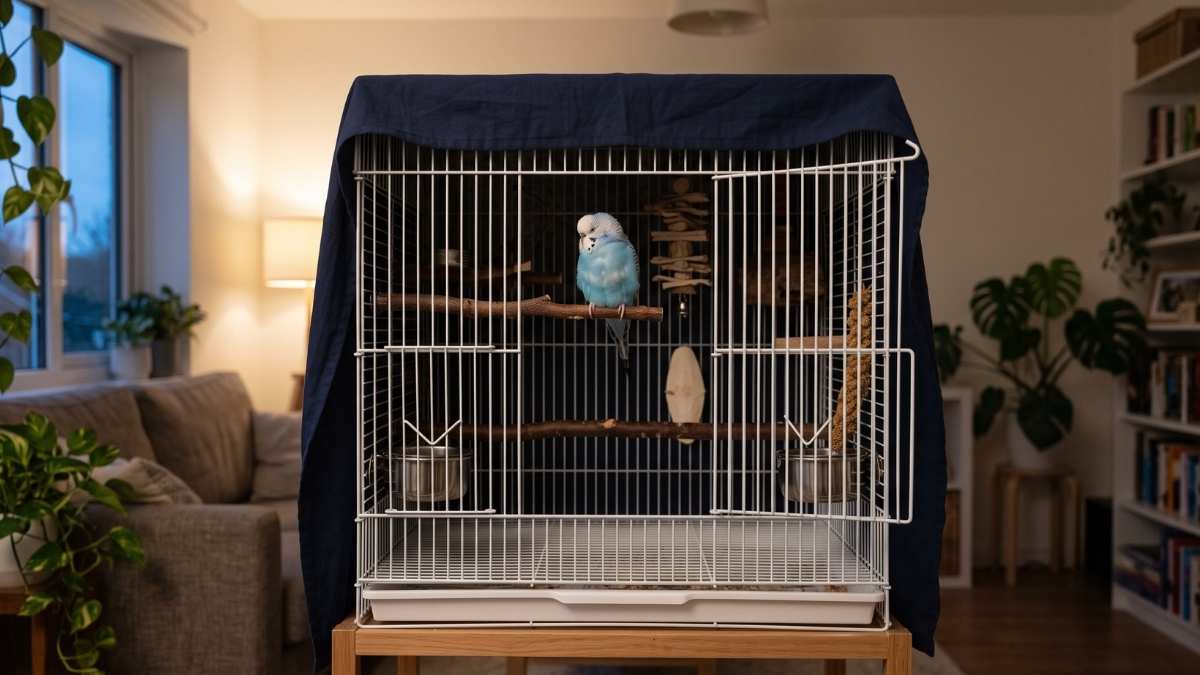
Budgies don’t strictly require a cage cover, but covering helps block ambient artificial light, prevents drafts, and signals bedtime. What they do need is 10 to 12 hours of uninterrupted darkness every day, and a cover is one of the simplest ways to guarantee it.
So, do parakeets need to be covered at night? Only if your home can’t provide that darkness otherwise. Light cues drive a budgie’s circadian rhythm, and that rhythm governs melatonin release, feeding patterns, and reproductive hormones. Proper sleep management is just one foundational pillar of daily bird upkeep—if you are setting up daily care routines for the first time, review our complete foundation in How to Take Care of a Parakeet: A Beginner’s Guide. Chronic light exposure at night can keep a bird in a state of hormonal readiness, which is linked to egg-laying in hens, excessive regurgitation, and territorial aggression. Poor sleep also shows up as irritability and feather-picking.
Covering is most useful when the cage sits in a living area with TV glow, streetlights, or late-evening foot traffic, or when the room runs cold. It is less suitable for birds prone to night frights, the sudden thrashing episodes that can follow a startle. A fully draped cage leaves a panicked bird disoriented in total blackness. For these birds, a partial cover with a dim nightlight, or a quiet, dark room with no cover at all, is usually safer.
Key Benefits of Covering Your Budgie’s Cage (And Why Full Darkness Matters)
Regulating the 10–12 Hour Sleep Cycle
Budgies evolved under equatorial-adjacent Australian skies, where daylight shifts only modestly across seasons. Their bodies expect roughly 10 to 12 hours of real darkness and 12 to 14 hours of light. Consistent parakeet sleep hours keep melatonin cycling normally, which supports digestion, immune function, and feather condition.
When darkness is cut short by lamps or a television, the hormonal signal for breeding season can stay switched on. In practice, owners see this as chronic egg-laying in hens, relentless regurgitating, cage-guarding, nipping, and contact calling that sounds like screaming at dusk and dawn. A reliable cover time, ideally the same hour each night, removes the variable and makes the whole routine predictable for the bird.
Blocking Artificial Household Lights and Noise
Budgies sleep lightly, and their eyes respond to far less light than ours do. A living room TV flickering across the cage, headlights sweeping a window, a streaming-box LED, or a hallway bulb left on can all fragment sleep without ever visibly waking the bird.
A cover mutes much of this stimulation and softens sudden household sounds. It will not make a loud room quiet, so the best placement is still a low-traffic space. If you are weighing a safe bird cage cover material, choose tightly woven, breathable cotton or a similar fabric with no loose threads, fraying edges, or looped weaves that toenails can catch. Avoid plastic-backed, thermal, or heavily padded covers, which restrict airflow, and skip anything with a chemical odor or non-stick coating, since birds’ respiratory systems are highly sensitive to fumes.
The 3-Sided Partial Covering Rule
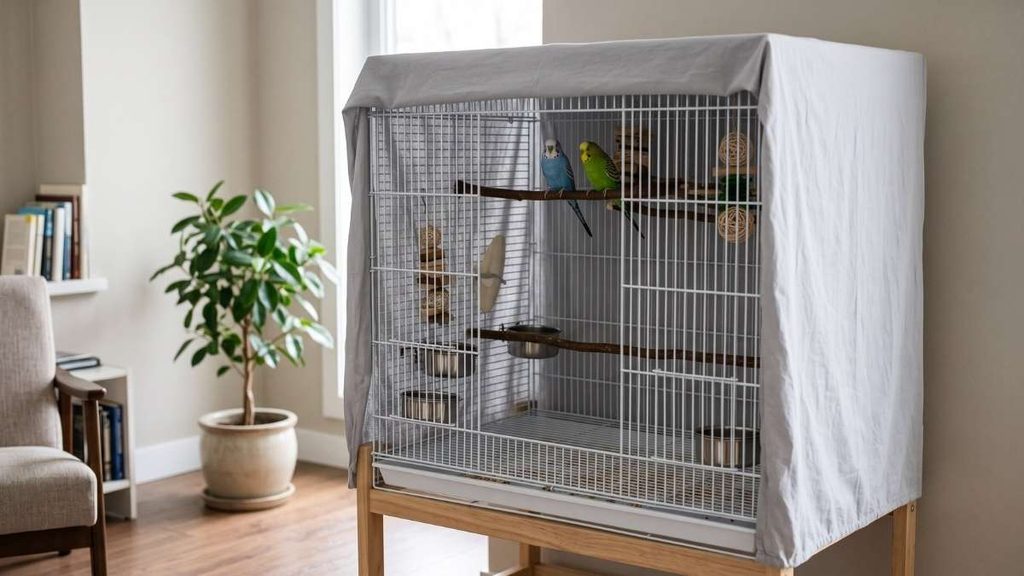
If you are asking should I cover my budgie cage at night, the safest middle ground for most birds is covering three sides and the top, leaving the front open. This keeps the sleeping bird sheltered from drafts and visual disturbance while preserving ventilation and a faint sense of the room.
That open side matters most for budgies prone to budgie night frights. If something startles a bird in total blackness, it may fall, flail, and injure itself on bars or toys. With a little ambient room light filtering in, the bird can orient itself and settle quickly. Keep the front dim, never lit.
Safe Materials for Night Covers (What to Use vs What to Avoid)
The fabric you choose matters as much as the decision to cover. A cover sits inches from a small bird’s face for ten hours or more, so it has to let air move, hold no heat, and offer nothing a toenail can snag.
Best Breathable Fabrics to Use
A safe bird cage cover material is lightweight, tightly woven, and made from natural fiber. Plain cotton is the standard choice: a percale or muslin sheet, a cotton pillowcase, or a purpose-made cotton cage cover. Linen works too, provided the weave is tight and the hems are finished. Both fabrics let air pass through while still dimming light and blocking drafts.
Look for these features:
- Tight, even weave with no loops, pile, or terry texture
- Finished, stitched hems so no edges can unravel
- Machine-washable fabric, since dust and feather dander build up quickly
- Light color or dark color, as needed. A darker shade blocks more light, but make sure the dye is colorfast and fully washed before first use
Wash any new cover before use to remove manufacturing residue, and use fragrance-free detergent. Birds’ respiratory systems are far more sensitive to scents and fumes than ours.
Dangerous Materials That Cause Overheating and Injury
Heavy wool blankets, quilts, comforters, and fleece trap heat and restrict airflow. A budgie in a cage wrapped in thick fabric can overheat or breathe stale, carbon dioxide-rich air, especially in a small cage. Warning signs include panting, wings held away from the body, and lethargy in the morning. Any of these means you should uncover the cage and contact an avian vet.
Frayed and loosely woven fabrics create a different hazard. Loose threads and looped weaves, such as crochet, knit throws, and worn towels, can wrap around toes, claws, or legs. A tangled bird that panics can fracture a leg or lose a toe to restricted circulation. Plastic-backed, thermal, or rubberized covers and airtight synthetics also prevent proper ventilation, and some off-gas fumes that can harm the lungs.
Inspect covers monthly for wear, and retire any that begin to fray. These are exactly the kinds of equipment errors we break down in What Not to Do With Parakeets: 10 Common Mistakes That Scare or Harm Your Budgie, where airtight synthetic fabrics and frayed blankets rank among the most preventable cage hazards.
Covering and Budgie Night Frights: Finding the Balance
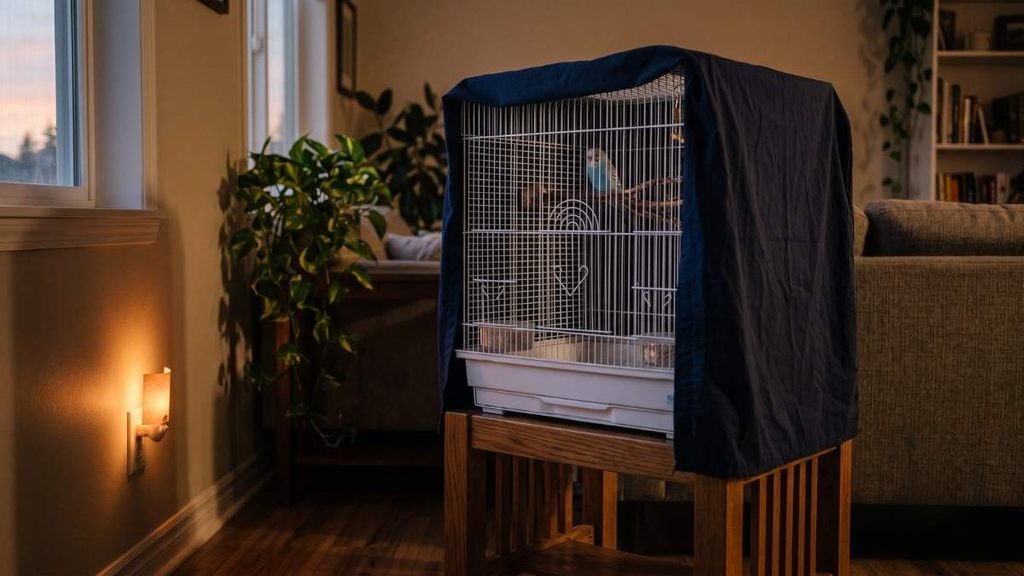
Night frights are sudden episodes in which a sleeping budgie bolts off its perch, thrashes against the bars, and often cries out. A distant car backfire, a pet jumping onto furniture, or a moth fluttering near the cage can trigger one. They are most common in English budgies, young birds, and birds in new homes, and they can happen even to calm, well-adjusted pets.
Why Total Darkness Can Make Frights Worse
Budgies have poor night vision, and a fully covered cage in a dark room leaves them effectively blind. A startled bird cannot locate its perch, so it flaps toward bars, toys, or the cage floor instead of settling. Injuries from these crashes include broken blood feathers, cuts on the cere or feet, and in rare cases fractures. If your bird has had even one episode, blackout conditions are the first thing to change.
Setting Up a Soft Night Light
Place a dim, low-wattage nightlight a few feet from the open front of the cage, not directly on it. The glow should be just enough to make out perch silhouettes, not enough to read by. Choose a warm, steady, non-flickering bulb, and avoid blue-white LEDs and anything with a blinking indicator. Pair it with the three-sided cover so the bird gets shelter on most sides and a faint point of reference at the front. Keep the cage in a room away from foot traffic and ensure perches are low and stable, with no dangling toys near the sleeping spot.
What to Do If Your Bird Panics at Night
Stay calm and move slowly. Turn on a dim light rather than a bright one, and speak in a low, quiet voice. Do not grab the bird unless it is trapped or visibly bleeding. Once the thrashing stops, check that the bird has returned to a perch and look for blood, drooping wings, or labored breathing. The calming routine in How to Calm Down a Parakeet: 7 Gentle Ways to Soothe a Stressed Budgie walks through the steps in order, from dimming the room to gentle verbal reassurance.
Contact an avian vet the same day if you see bleeding that does not stop quickly, an inability to perch, or repeated frights across several nights.
Establishing a Consistent Nighttime Routine
Budgies thrive on predictability. So, do parakeets need to be covered at night? Not always, but they do need the same sequence of cues every evening, whether or not a cover is part of it. A repeatable routine tells the bird that sleep is coming and keeps parakeet sleep hours stable.
A 4-Step Evening Routine
- Set a consistent bedtime. Choose a time that gives 10 to 12 hours before your usual morning light, and keep it within about 30 minutes every day, weekends included.
- Dim the lights 30 minutes beforehand. Lower room lighting and switch off the TV near the cage. This mimics dusk and lets melatonin rise naturally.
- Offer gentle vocal reassurance. Use the same quiet phrase each night, such as “goodnight,” before applying a three-sided cover or switching on the nightlight.
- Check the room temperature. Aim for a steady, draft-free room, roughly 65 to 80°F (18 to 27°C). Keep the cage away from windows, vents, and kitchens.
Morning Wake-Up Cues
A well-rested budgie wakes alert but unhurried. Expect wing and leg stretches, a good shake of the feathers, soft chatter, and an appetite for breakfast. Relaxed, melodic chirping is a good sign, and How Do I Know If My Parakeet Is Happy? explains how to read these sounds alongside body language. Warning signs include sleeping fluffed up with eyes closed during the day, persistent screaming at dawn, or listlessness, all of which merit a call to an avian vet.
Sources & Veterinary References
- Merck Veterinary Manual: Management of Pet Birds
- Lafeber Company: Pet Bird Behavior & Sleep
Disclaimer: This article is for educational purposes only and does not replace professional veterinary advice. If your budgie shows signs of illness, injury, or distress, consult a qualified avian veterinarian.