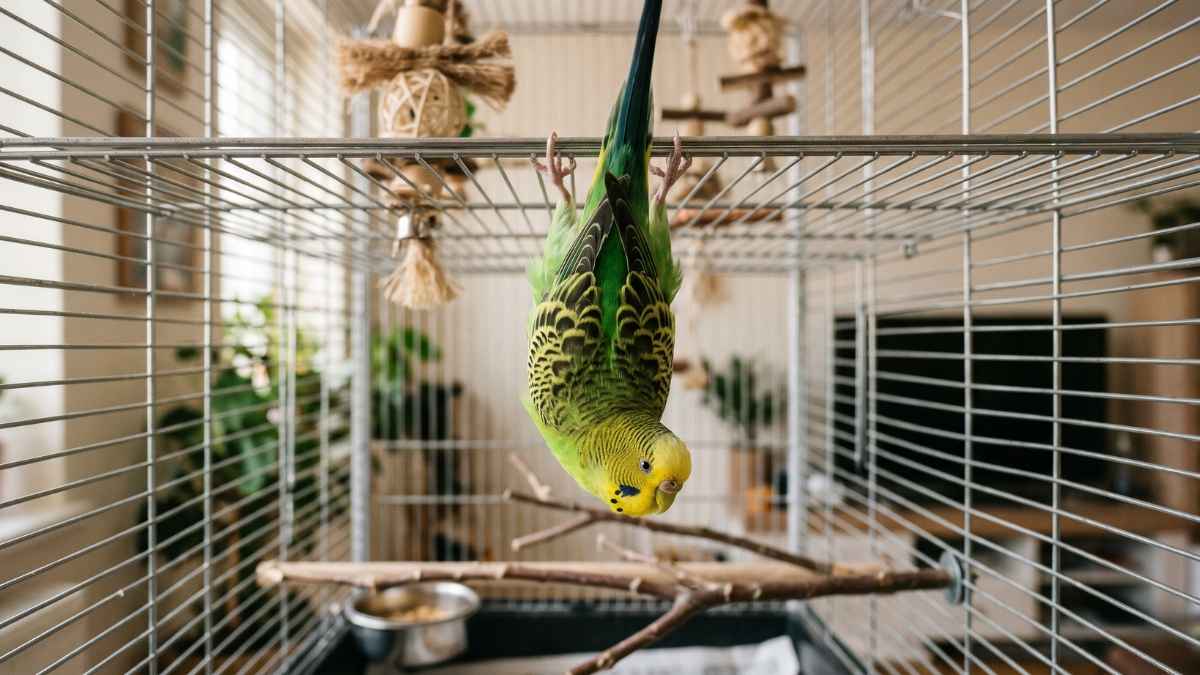
If you’ve caught yourself wondering why is my budgie hanging upside down from the cage ceiling, the answer is usually reassuring: it is often normal, playful behavior. Seeing your parakeet dangling like a tiny feathered bat can be startling the first time, but an alert bird that climbs, swings, and explores comfortably is often simply enjoying its surroundings. However, the posture alone cannot confirm that a bird is healthy.
Parakeet Hanging Upside Down Like a Bat: Built for Acrobatics
Budgies are naturally agile climbers. In their native Australian grasslands, they move through grasses and vegetation while searching for seeds. Clinging, climbing, balancing, and changing positions are all part of their natural movement.
Their anatomy helps them do this:
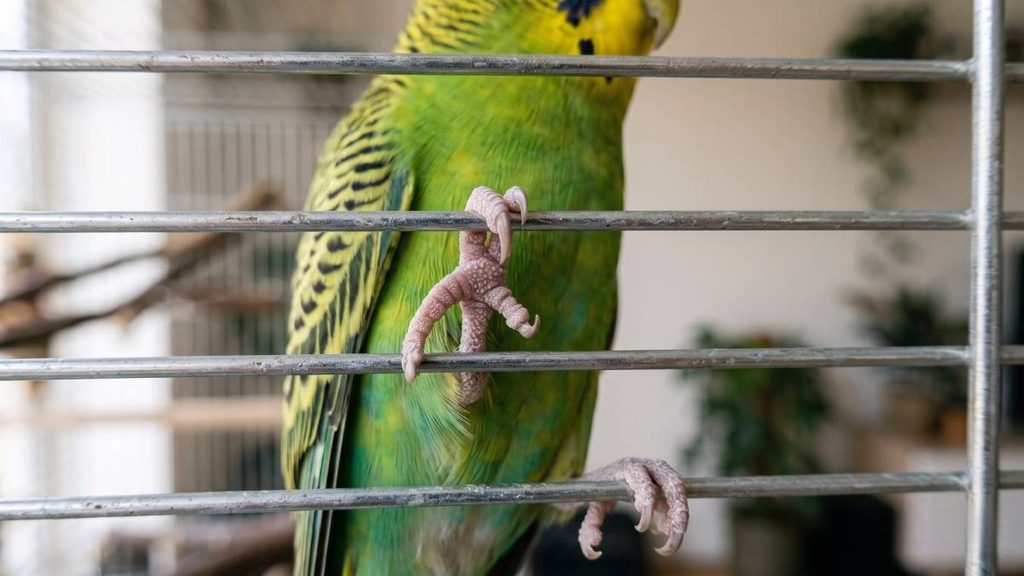
- Zygodactyl feet: Two toes point forward and two point backward, creating a strong grip that helps them hold onto branches, bars, and other surfaces.
- A tendon-locking mechanism: When a budgie bends its legs around a perch, tendons help keep its toes gripping securely without requiring constant muscular effort.
- Strong, flexible bodies: Powerful legs, a mobile neck, and good balance help them climb, swing, and change positions with ease.
So when your budgie clings to the cage roof, a bar, or a toy and swings upside down, it is using its natural climbing and balancing abilities. In an otherwise alert and active bird, this is usually nothing to worry about.
Common Reasons Parakeets Hang Upside Down
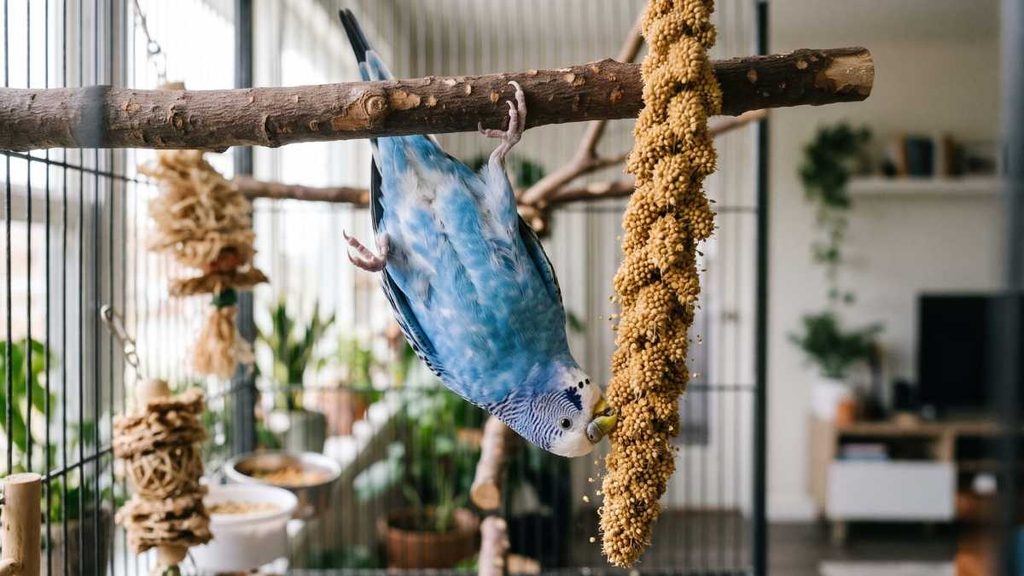
Most upside-down hanging comes down to a few simple, harmless reasons:
- Playing: Budgies treat ropes, bells, and cage bars like a jungle gym. This kind of budgie acrobatics, especially in an alert and active bird, is commonly part of normal play.
- Stretching: Hanging and changing positions may accompany natural stretches of the legs, wings, and body.
- Getting a better view: From the cage roof, your budgie can watch the room, the window, or you from a new angle.
- Reaching a toy or treat: A dangling toy or millet spray may sit just out of reach, so your parakeet flips and stretches to get it.
Once you know the context, the upside-down parakeet meaning is often easy to understand.
Upside-Down Parakeet Behaviors
| Behavior Context | What It Means | Owner Action |
| Playing | Normal exercise and exploration | Enjoy it, and rotate toys to keep things interesting |
| Stretching | May be part of normal body and wing movement | No action needed if the bird is comfortable |
| Reaching for a toy or treat | Natural exploration and problem-solving | Offer safe foraging toys and hang treats at accessible heights |
| Sleeping | Unusual for most budgies and worth observing | Check the bird’s overall condition and seek veterinary advice if the posture is new or accompanied by other changes |
| Foot or toe stuck | A claw or toe is caught in rope, mesh, or a toy | Stay calm, avoid pulling, and carefully remove the hazard if it can be done safely |
| Thrashing or frantic flapping | Possible panic, fear, or entanglement | Reduce stimulation, provide gentle light, and help only if the bird is caught or in immediate danger |
Is It a Sign of a Happy Budgie?
In many cases, upside-down acrobatics are part of normal, playful behavior. A budgie that willingly climbs, swings, and explores its cage may be comfortable with its surroundings. However, this behavior alone does not prove that a bird is happy or healthy. Look at its overall activity, appetite, vocalization, and normal daily habits as well.
What Happy Upside-Down Behavior Looks Like
A relaxed, playful budgie might:
- Hang by one foot: Dangling from a single foot while the other foot grooms a feather or holds a bit of millet.
- Swing and sway: Rocking back and forth on a rope or the cage roof as if on a trapeze.
- Vocalize while upside down: Chirping, chattering, or singing while hanging.
- Stay bright and alert: Clear eyes, responsive behavior, and an active interest in everything around it.
- Return to normal activity: After a few moments, your bird flips upright, eats, preens, and plays like usual.
Why Your Cage Setup Matters
This behavior may be encouraged by a comfortable, enriched environment. Budgies often explore and climb when they have varied perches, safe toys, and enough space to move. If your bird is doing this regularly while remaining active and alert, it may simply be enjoying its surroundings. For a fuller picture, see our guide to the signs your parakeet is happy and healthy, including body language, chatter, and appetite.
Sleeping Upside Down: Should You Worry?
Finding your budgie sleeping upside down can be alarming, especially if you spot it in the dim light of evening. Most budgies sleep upright on a perch, often with one foot tucked up. Some may occasionally rest while clinging to cage bars or other surfaces, but sleeping upside down is not the typical sleeping position.
Why Some Birds Choose a High, Odd Spot
- Security: Budgies naturally prefer elevated places for resting. A bird that feels comfortable near the top of the cage may choose a high spot.
- Personal preference: Individual birds can develop unusual resting habits.
- Comfort: A perch that is too thick, too slippery, or poorly placed may make another resting spot more appealing.
Healthy Sleeper vs. Sick Bird
The key is to look at the whole bird, not just the pose. If your budgie occasionally rests in an unusual position but wakes normally, eats well, moves comfortably, and remains active, observe whether the behavior continues.
A sick bird may show additional warning signs, such as sitting puffed up and drowsy for long periods, reduced appetite, weakness, breathing changes, or spending unusual amounts of time on the cage floor. If you notice these signs, contact an avian veterinarian promptly. Our guide on why a budgie is fluffed up and sleeping a lot explains other warning signs to watch for.
If upside-down sleeping is new, happens repeatedly, or comes with any change in your bird’s normal behavior, arrange an avian veterinary assessment rather than assuming it is harmless.
Step in immediately if a foot or toe is physically caught, or if the bird is thrashing in panic.
When Upside-Down Behavior Means Trouble
Hanging upside down is often normal, but two situations call for quick, calm action: a trapped foot and a bird in panic.
A Stuck Nail, Toe, or Foot
Long nails and loose loops are common hazards. A claw can snag on rope fibers, frayed fabric, toy hooks, or the wire mesh of the cage. Signs include:
- Your budgie is hanging and cannot flip upright or release its grip.
- Persistent flapping or struggling in the same spot.
- A foot held at an unusual angle.
What to do:
- Stay calm and speak softly, since your bird may react to sudden movements and noise.
- If possible, support the bird’s body gently to reduce the weight pulling on the trapped foot. Never squeeze its chest, as birds need unrestricted chest movement to breathe.
- Carefully free the snagged claw or toe only if it can be done without pulling or causing further injury. If a loose thread or rope is wrapped around it, cut the material away carefully rather than pulling it.
- If the foot is tightly trapped, the bird is injured, or you cannot free it safely, contact an avian veterinarian immediately.
If you see swelling, bleeding, or the bird will not put weight on the foot, seek veterinary attention promptly.
Night Frights and Panic
Sudden noises, shadows, or a flashing light can trigger a night fright, leaving a budgie clinging to the roof or thrashing in the dark. If your bird is hanging upside down while frantically flapping, it may be frightened or caught. Turn on a dim light, speak quietly, and check whether the bird is tangled. Avoid chasing or grabbing it unnecessarily. See our guide on how to calm down a parakeet for step-by-step techniques.
Check the Feet Safely
Every few weeks, look at your budgie’s nails and toes. Overgrown nails may snag on cage materials and toys. Have an avian vet or experienced groomer trim them when needed, and provide perches with varied diameters and suitable textures to support natural nail wear.
Enjoy the Acrobatics
So, the “bat-bird” pose is simply another charming quirk of life with a budgie. In an otherwise bright, alert, and active parakeet, hanging upside down is usually normal climbing or play behavior. Step in when a foot or toe is caught, when your bird is thrashing in panic, or when the behavior appears alongside signs of illness or injury.
To support that natural agility, give your budgie plenty of room to play:
- Swings and ropes: Choose bird-safe options without loose loops or fraying fibers.
- Climbing toys: Ladders, perches of varied widths, and play gyms that encourage movement.
- Foraging toys: Safe toys and treats that reward stretching and problem-solving.
Check toys regularly for frayed fibers, loose loops, and damaged parts, and remove anything that could trap your bird’s toes or claws.
Sources & References
- Budgie Anatomy & Natural Climbing: Animal Diversity Web, University of Michigan (Melopsittacus undulatus Profile)
- Play Behavior & Species Overview: Lafeber Company (Budgie/Parakeet Care & Personality)
- Signs of a Sick Bird & Veterinary Care: VCA Animal Hospitals (Recognizing Illness in Pet Birds)
Disclaimer: This article is for educational purposes only and is not a substitute for professional veterinary advice, diagnosis, or treatment. If your budgie shows signs of illness or injury, consult a qualified avian veterinarian.